
Binder layouts
How do you lay out a Pokémon set in a binder? A page-by-page plan for Chaos Rising
Three ways to lay out one real Pokémon set on nine-pocket pages, with the page count and spread for each.
By Matt Kellar — Founder · Published · Updated

You have opened enough Chaos Rising to start a binder, and you are about to sleeve the first card into the top-left pocket. Stop for five minutes first. The best way to lay out a Pokémon set is to decide where every card goes before any of them go in: main set in number order, then the secret rares starting on a fresh spread. For this set that means 15 nine-pocket sides, with one left blank on purpose.
If you searched for a Pokémon 3-ring binder: skip the rings if you can. A ringless binder protects cards far better, and our guide on why to avoid ring binders for cards explains why. The plan below works in any binder. It walks through one real set, Chaos Rising, and the same steps work for any modern set.
Read the set number before you count
Every modern Pokémon card has a number printed in the corner, like 001/086. The second number is the printed set size. Cards numbered above it are the secret rares.
For Chaos Rising the printed size is 086. Our catalog lists 122 cards, so 36 of them sit above that number. They break down like this, all taken from the catalog:
| Numbers | What they are | Cards |
|---|---|---|
| 001 to 086 | Main set: commons, uncommons, rares and double rares | 86 |
| 087 to 097 | Illustration Rares | 11 |
| 098 to 115 | Ultra Rares | 18 |
| 116 to 121 | Special Illustration Rares | 6 |
| 122 | Mega Hyper Rare (Mega Greninja ex) | 1 |
That split is the first decision. Do you file all 122 cards in one run of numbers, or keep the main set and the secret rares apart?
Option one: one straight run of numbers
The simplest plan is 001 to 122 in order, nine cards per side.
- 122 cards on nine-pocket pages is 14 sides, which is 7 sheets.
- The last side holds cards 118 to 122 and has 4 empty pockets.
It is easy to keep up, and anyone can find a card by its number. The downside is that the secret rares start in the middle of a page. Card 087, the first Illustration Rare, lands in the middle of side 10, right after the last commons and uncommons.
Option two: main set first, then a fresh spread for the chase
Most collectors prefer the secret rares to start on their own page. Here is the count:
- The main set, 001 to 086, needs 10 sides. The tenth side has 4 empty pockets at the end.
- The 36 secret rares need exactly 4 sides, with no gaps.
Now think about spreads. When the binder is open you see two sides at once. The first side after the front cover is a right-hand page on its own. After that the sides pair up: 2 with 3, 4 with 5, and so on.
The main set ends on side 10, a left-hand page, facing side 11. If the Illustration Rares start on side 11, they share a spread with the end of the main set. If you want them to open on a clean spread, leave side 11 empty and start them on side 12. That way 087 to 104 fill spread 12 and 13, and 105 to 122 fill spread 14 and 15.
Look at what lands on the last spread: the six Special Illustration Rares and the Mega Hyper Rare, all on one open page with the end of the Ultra Rares.
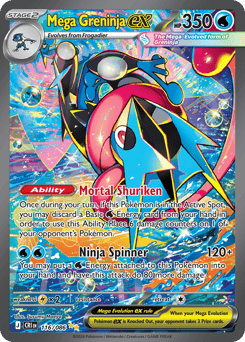
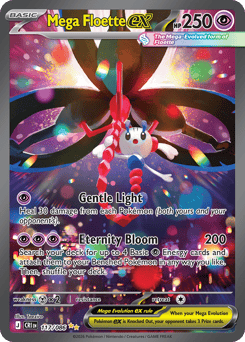
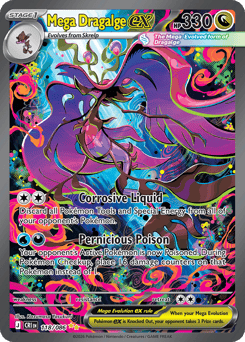
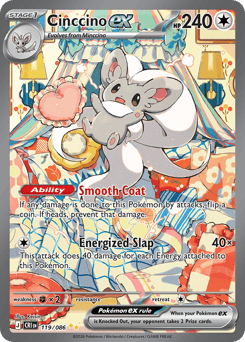
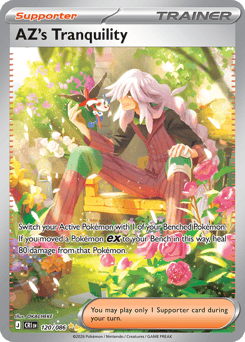

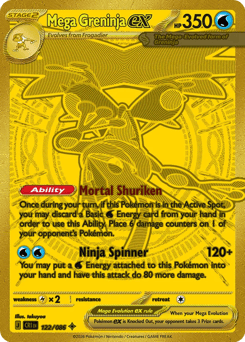
It costs you one blank side: 15 sides in use, so 8 sheets with the back of the last one spare. Most people think that is worth it.
Option three: sort by Pokémon, not by number
Some collectors arrange a binder by National Pokédex number, or put every version of one Pokémon together. In this set, Mega Greninja ex appears at both 116 and 122, so a "by Pokémon" binder puts them side by side.
This is the nicest binder to flip through and the hardest one to keep up. Every new card means working out where it belongs, and gaps are harder to see. If you go this way, keep a list of what is missing somewhere other than the binder itself.
Leave the gaps where the missing cards go
Whatever order you choose, sleeve what you have into the slot it will end up in, and leave empty pockets for what you are missing. It is tempting to fill pages from the front and reorder later. But reordering means sliding cards out of sleeves and pockets again, and that is when corners get dinged. In a ringless binder you cannot add a page later either, so a gap left now is cheaper than a reshuffle later.
With a fixed slot for every card, a glance at the page shows exactly what is missing. Your first sleeving session also becomes your last one for that set.
The full checklist
Here is the whole set as our catalog has it, in number order. Use it to count what you own before you buy pages.
Chaos Rising checklist
122 cards
- #1 Weedle
- #2 Kakuna
- #3 Beedrill ex
- #4 Carnivine
- #5 Chespin
- #6 Quilladin
- #7 Chesnaught
- #8 Vulpix
- #9 Ninetales
- #10 Ho-Oh
- #11 Fennekin
- #12 Braixen
- #13 Delphox
- #14 Litleo
- #15 Mega Pyroar ex
- #16 Remoraid
- #17 Octillery
- #18 Delibird
- #19 Keldeo
- #20 Froakie
- #21 Frogadier
- #22 Mega Greninja ex
- #23 Bergmite
- #24 Avalugg
- #25 Wimpod
- #26 Golisopod
- #27 Mareep
- #28 Flaaffy
- #29 Ampharos
- #30 Emolga
- #31 Deoxys
- #32 Deoxys
- #33 Deoxys
- #34 Deoxys
- #35 Mega Floette ex
- #36 Espurr
- #37 Meowstic
- #38 Phantump
- #39 Trevenant
- #40 Pumpkaboo
- #41 Gourgeist ex
- #42 Xerneas
- #43 Sudowoodo
- #44 Phanpy
- #45 Donphan
- #46 Baltoy
- #47 Claydol
- #48 Mega Gallade ex
- #49 Zubat
- #50 Golbat
- #51 Crobat
- #52 Qwilfish
- #53 Stunky
- #54 Skuntank
- #55 Krookodile ex
- #56 Trubbish
- #57 Garbodor
- #58 Skrelp
- #59 Beldum
- #60 Metang
- #61 Metagross
- #62 Ferroseed
- #63 Ferrothorn
- #64 Cobalion ex
- #65 Mega Dragalge ex
- #66 Goomy
- #67 Sliggoo
- #68 Goodra
- #69 Tauros
- #70 Patrat
- #71 Watchog
- #72 Minccino
- #73 Cinccino ex
- #74 Adversity Policy
- #75 Ange Floette
- #76 AZ's Tranquility
- #77 Emma
- #78 Great Haul Net
- #79 Philippe
- #80 Prism Tower
- #81 Roxie's Performance
- #82 Special Red Card
- #83 Transformation Tome
- #84 Bubbly Water Energy
- #85 Magnetic Metal Energy
- #86 Nitro Fire Energy
- #87 Chespin
- #88 Froakie
- #89 Frogadier
- #90 Ampharos
- #91 Xerneas
- #92 Claydol
- #93 Crobat
- #94 Metang
- #95 Sliggoo
- #96 Tauros
- #97 Watchog
- #98 Beedrill ex
- #99 Mega Pyroar ex
- #100 Mega Greninja ex
- #101 Mega Floette ex
- #102 Gourgeist ex
- #103 Cobalion ex
- #104 Mega Dragalge ex
- #105 Cinccino ex
- #106 AZ's Tranquility
- #107 Emma
- #108 Energy Retrieval
- #109 Jumbo Ice Cream
- #110 Philippe
- #111 Prism Tower
- #112 Roxie's Performance
- #113 Special Red Card
- #114 Surfing Beach
- #115 Tool Scrapper
- #116 Mega Greninja ex
- #117 Mega Floette ex
- #118 Mega Dragalge ex
- #119 Cinccino ex
- #120 AZ's Tranquility
- #121 Roxie's Performance
- #122 Mega Greninja ex
The binder itself
A set planned this carefully deserves a binder that will not bend it. The best choice is a ringless binder with side-loading pockets and enough nine-pocket sides for the plan you picked: 14 for option one, 15 for option two. If you do use rings, use D-rings mounted on the back cover, and keep the Special Illustration Rares out of the column of pockets nearest the rings. Avoid round rings entirely. Our guide on why to skip ring binders for cards covers the reasons. For the habits worth dropping, Deep Pocket Monster's binder storage video shows what he calls Bad Binder Behavior on real cards.
Try the layout before you sleeve it
The quickest way to settle between the three options is to see them. In 3Ring you can build the binder with real nine-pocket pages, drop the set in, and switch between number order and a chase-first layout without moving a card. The missing slots show up per binder, so at a card show you know exactly which numbers you still need. For other sets, start from the Pokémon set list. To see how other collectors lay out their binders, browse Community.
Frequently asked questions
How many binder pages do I need for Chaos Rising?
On nine-pocket pages, the full 122-card set needs 14 sides in number order, or 15 if the secret rares start on their own spread. That is 7 or 8 sheets.
Should secret rares go at the back or in number order?
Either works. Number order is easiest to keep up. Putting the secret rares on their own spread at the back makes the chase cards the thing people see when they flip to the end.
Where should I put cards I do not have yet?
Leave their pockets empty. Every card gets a fixed slot from day one, so the gaps double as your want list and you never reshuffle sleeved cards.
Do I need a different plan for a 12-pocket binder?
The same steps work; only the math changes. 122 cards on twelve-pocket pages is 11 sides. Check where the secret rares start and whether they land on a fresh spread.
Sources
- Chaos Rising card list, numbering and rarities: 3Ring catalog.
- The CORRECT Way To Store Pokemon Cards in a Binder, Deep Pocket Monster on YouTube: Bad Binder Behavior.
- Cover image: Chaos Rising set logo, from the 3Ring catalog.